


Conductive vs. Antistatic Bags: What's the Difference?

1. Basic Definitions: What Do Conductive and Antistatic Mean?
In the world of ESD packaging, the two most commonly confused product groups are undoubtedly conductive bags and antistatic bags. Both are designed to protect electronic components from static electricity, but the way they provide this protection and the scope of protection they offer differ fundamentally.
Produced by adding an antistatic additive to polyethylene raw material. By keeping surface resistance in the 10⁸–10¹¹ Ω range, it prevents static charge buildup from forming. It dissipates charge but does not conduct it. Usually pink, yellow or transparent.
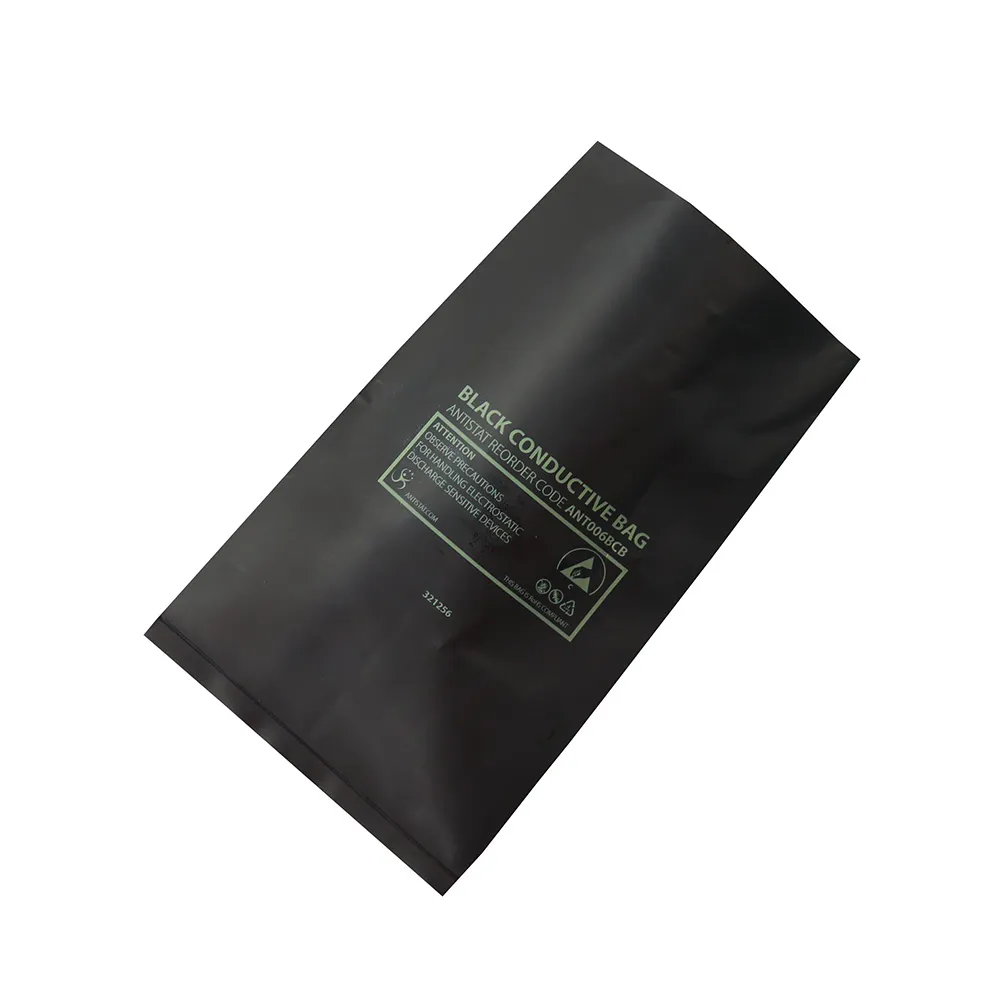
Made from a carbon- or metal-loaded polymer-based material. Surface resistance is below 10⁴ Ω. Electrical charges are rapidly conducted and dissipated. Usually black. Designed for use inside an EPA.
A conductive bag actively conducts electrical charge — just like a wire. An antistatic bag, on the other hand, passively prevents charge buildup — just like a buffer. The difference between the two is as great as the difference between a fire extinguisher and a fire alarm.
— Öney Engineering Technical Team, in line with IEC 61340 terminology2. Electrical Operating Principles
How the Antistatic Bag Works: Charge Dissipation
An antistatic bag forms a thin conductive layer thanks to chemical additives that migrate to its surface. This layer spreads any charge that may form on the surface over a wide area — so critical charge density is never reached at any single point. In technical terms, this process is called triboelectric charge dissipation.
However, this mechanism has an important limitation: an antistatic bag only prevents charge from building up on its own surface. An external electrostatic field or a discharge caused by human contact can easily reach the component inside the bag. → What Is an Antistatic Bag? Comprehensive Guide
How the Conductive Bag Works: Rapid Conduction
Thanks to its carbon or metal additive, a conductive bag has extremely low electrical resistance. This low resistance instantly and evenly distributes any electrical charge reaching the bag's surface across the entire surface. The charge is conducted and neutralized before it can build up.
Although this mechanism is powerful, it requires careful handling: if the conductive bag comes into direct contact with the component inside, the charge carried by the bag can be transferred to the component.
Difference from the Shielding Bag
There is a problem that neither bag can solve: blocking an external electrostatic field. This function belongs only to metallic shielding bags. A shielding bag is mandatory whenever ESDS components need to leave the EPA. → What Is ESD Packaging? Comprehensive Guide
3. Comprehensive Comparison Table
| Feature | Antistatic Bags | Conductive Bag | Metallic Shielding Bag |
|---|---|---|---|
| Surface resistance | 10⁸ – 10¹¹ Ω | < 10⁴ Ω | Multilayer (10⁴–10¹¹ Ω) |
| IEC 61340 class | Antistatic | Conductive | Shielding |
| Prevents charge buildup on its own surface | Yes | Yes | Yes |
| Blocks external ESD fields | No | No | Yes |
| Risk of contact with the component | Low | Requires care | Low |
| Use inside the EPA | Suitable | Suitable | Suitable |
| Outside the EPA / external shipping | Not suitable | Not suitable | Essential |
| Typical color | Pink / yellow / transparent | Black | Silver metallic |
| Content visibility | Transparent model available | Opaque | Semi-transparent |
| Cost | Low | Low–Medium | Medium–High |
| Moisture barrier | No | No | Some models |
| Typical application | Intermediate transport inside the EPA | Trays, in-process production | External shipping, delivery |
4. Which One to Use and When?
5. Common Mistakes
- Mistaking a black conductive bag for a shielding bag: Black is the characteristic color of a conductive bag — but that does not make it a shielding bag. It offers no external field protection.
- Using a conductive bag for external shipping: A conductive bag provides no protection outside the EPA. During delivery, the component is left completely exposed.
- Using an antistatic bag instead of a conductive tray: In tray systems, an antistatic bag is mechanically unsuitable. A conductive tray or conductive foam should be preferred.
- Assuming every black bag is conductive: Color alone does not guarantee electrical properties — a test report is essential.
- Putting non-ESD foam inside a conductive bag: Ordinary foam accumulates static charge. All materials inside a conductive bag must be ESD-compliant.
- Assuming the two bags complement each other: Placing a conductive bag inside an antistatic bag provides no additional protection. Each has its own separate function.
6. Combined Use: The Right Combination
| Stage | Recommended Packaging | Rationale |
|---|---|---|
| Warehouse → Production line entry | Metallic shielding bag | Transport outside the EPA — external field protection required |
| In-line production transport | Antistatic bag or conductive tray | Charge buildup is prevented inside the EPA |
| Waiting at the test station | Antistatic bag | Short-term waiting inside the EPA |
| Final packaging → shipping | Metallic shielding bag | Outside the EPA — external field protection mandatory |
| Long-term storage (inside the EPA) | Antistatic bag + desiccant | Combined moisture and static control |
Standards and Certification
| Standard | Antistatic Bags | Conductive Bags |
|---|---|---|
| IEC 61340-5-1 | Applicable | Applicable |
| IEC 61340-4-1 (Surface resistance measurement) | Applicable | Applicable |
| ANSI/ESD STM11.11 | Applicable | Applicable |
| ANSI/ESD STM11.31 (Shielding test) | Not applicable | Not applicable |
| MIL-PRF-81705 | Conditional | Conditional |
Documents to Request from Your Supplier
- Surface resistance test report prepared according to IEC 61340-4-1 or ANSI/ESD STM11.11
- CoC (Certificate of Conformance) for each lot
- Production date and shelf-life declaration
- Additive / carbon content type information
- Independent third-party laboratory approval, if available
Frequently Asked Questions
The most frequently asked questions about conductive and antistatic bags.
Not Sure Which Bag You Should Use?
At Öney Engineering, we offer free technical consultancy on choosing the right ESD packaging. We evaluate your production process and component range together and recommend the most suitable solution for you.
For More Information Product Catalogue